
 Dr. Julia Tzu, MD, FAAD, FACMS
Triple Board-Certified Dermatologist
Fellowship-Trained in Procedural Dermatology and Dermatopathology
Founder, Wall Street Dermatology in New York City since 2014
About Dr. Tzu
Dr. Julia Tzu is a triple board-certified dermatologist and founder of Wall Street Dermatology in New York City. She completed fellowship training in Procedural Dermatology and Dermatopathology and has been in practice for fifteen years. Her clinical focus includes cosmetic mole removal, scar revision, and surgical techniques designed to minimize scarring, optimize aesthetic outcomes, while maintaining diagnostic precision.
Learn more about Dr. Tzu and her clinical philosophy →
If you’ve searched for cosmetic mole removal in New York City, you’ve probably seen prices ranging from $250 to thousands of dollars — for what appears to be the “same” procedure.
So why the dramatic gap?
- Because not all moles are the same, not all mole removal procedures are the same, and not all providers are delivering the same level of cosmetic outcome.
Below is what actually drives pricing variation in NYC.
1. You’re Paying for Results — and Results Come from Specialization
Cosmetic mole removal is not just about removing a non-medical growth.
Since you’re doing this for aesthetic reasons, it’s 100% about what your skin looks like after it heals.
In a dense, image-conscious market like New York City, many moles being removed are on in areas where the eyes naturally focus:
- Cheeks
- Nose
- Lips
- Chin
- Neck
These are high-visibility areas where even a small scar can be noticeable. There are many providers who remove lesions. There are far fewer who specialize in cosmetic facial excision and meticulous closure technique for the most visible moles.
- Specialization matters because:
- Facial skin behaves differently than body skin
- Tension lines must be respected
- Closure technique determines scar width
- Layered suturing reduces scar spread
- Wound edge eversion affects long-term appearance
A skin surgeon who performs high-volume cosmetic skin surgery on the face daily is delivering a different service than someone who removes skin lesions occasionally. The best results come from highly-trained surgeons with thousands of procedures under their belt and who constantly are improving their already outstanding outcomes.
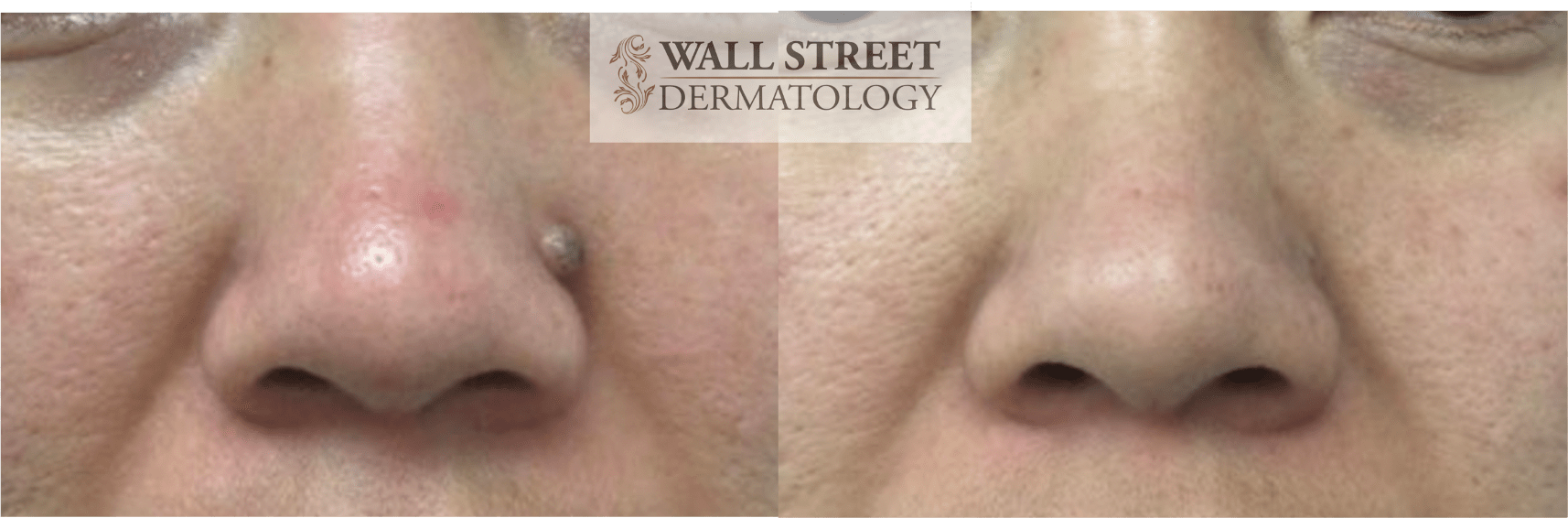
Pricing often reflects that difference.
2. Procedural Complexity Isn’t Obvious From the Surface
Two moles may look similar in photos. Procedurally, they may be very different.
Factors that affect complexity:
- Size
- Depth
- Border characteristics
- Location (high-tension vs low-tension area)
- Need for layered closure
- Need for pathology
- History of prior trauma or incomplete removal
A small cheek mole may require:
- Precise excision
- Layered sutures
- Careful alignment
- Extended closure time
- Scar optimization strategy
That is not comparable to a superficial shave in a low-tension area by a general doctor, which is where the pricing starting at $250 comes from.
When pricing varies, complexity is often the invisible variable. For ever more complex cases, the basket of available options narrow as the required skill level of the medical provider increases.
3. Closure Technique Changes the Outcome
This is one of the largest pricing drivers — and one of the least discussed.
Some providers:
- Perform quick shave removals that incompletely remove the mole.
- Perform shave removals that result in indented or raised scars.
- Do not suture
- Do not layer closures
- Do not account for facial tension lines
Others:
- Perform actual surgical excision for complete removal of the mole, a technique more advanced than shave removal.
- Utilize advanced surgical techniques to decrease length or width of the scar, which involves an even higher order of complexity and expertise.
- Use deep dermal sutures
- Precisely align wound edges
- Optimize eversion
- Provide structured aftercare
Closure time can range from 2–3 minutes to 20–30+ minutes.
Time matters. Quick but imprecise closures affect scarring.
Technical precision and expertise matters even more.
The outcome of the scar is the result.
4. Follow-Up and Scar Management
Lower advertised pricing may not include:
- Suture removal
- Follow-up visits
- Scar evaluation
- Steri-strip reinforcement
- Silicone scar therapy guidance
Higher-end surgical practices often incorporate these into the treatment plan.
Scar formation evolves over months.
Early management influences long-term appearance.
5. Pathology: Included or Not?
Some cosmetic removals include pathology evaluation. Others do not.
Sending tissue for dermatopathology involves:
- Specimen processing
- Lab fees
- Specialist interpretation
That cost alone can materially affect pricing.
If pathology is included, the fee will reflect that.
If it is optional or excluded, pricing will appear lower.
6. The NYC Market
In a competitive environment like New York City, you will find several different practice models:
- High-volume, speed-focused clinics where removal is not performed by a physician.
- Med spas where removal is performed by a physician whose core training is not in dermatology or plastic surgery.
- General dermatology practices that occasionally perform cosmetic lesion removal or other procedures.
- Cosmetic dermatology practices performing noninvasive cosmetic procedures but who do not specialize in surgical procedures.
- Cosmetic surgical dermatology practices specializing in cosmetic skin surgery.
These are not interchangeable services — even if search results group them together. Many providers advertising pricing that starts at $250 per mole are nonspecialists quoting the simplest cases, and may not have the advanced training to do the more complex ones.
If you are have a simple case of mole removal in an area of the body where scarring does not matter much, you will have more cost-effective options. In straightforward, low-risk situations, a lower-cost provider could potentially deliver a satisfactory result. However, if your mole is larger, deeper, located in a high-visibility area, or requires meticulous layered closure to optimize cosmetic outcome, you will likely benefit from evaluation and treatment by a trained specialist who performs these procedures routinely
What Patients Are Actually Buying
Most people think they’re paying for “mole removal.”
What they are actually paying for is:
- Minimal visible scarring
- Technical precision
- Expert lesion evaluation
- Appropriate excision technique
- Proper wound closure
- Pathology when indicated
- Structured follow-up
In cosmetic facial procedures, the true product is the long-term aesthetic result.

That is why pricing can range from $250 to thousands of dollars in NYC.
The Bottom Line
Wide pricing variation usually reflects differences in:
- Specialization
- Experience
- Technique
- Complexity
- Closure time
- Pathology inclusion
- Follow-up care
When evaluating cosmetic mole removal, the most important questions are not “What is the lowest price?” but:
- Who is performing the procedure?
- How often do they perform cosmetic facial excisions?
- What closure technique is used?
- Is pathology included?
- What follow-up care is provided?
In facial cosmetic surgery, the outcome is everything.
And outcomes are rarely accidental.
If you would like an individualized evaluation and a clear understanding of complexity, technique, and expected cosmetic outcome, you can request a consultation here.
For additional perspective, you can review our verified patient experiences and feedback